
Every business now runs on data spread across many different platforms – email, chat, drives, SaaS apps, ticketing systems, file servers and so on. Storing it is the easy part. Keeping it findable, secure, compliant and secure, cost efficiently over the several years is challenging. Most organisations would like to manage their data, especially unstructured data, better.
Three things have made this harder since we first wrote this guide.
- Most of the data growth is coming from the growth in new kinds of unstructured data, making it harder to map into tables and databases and structured searches.
- AI projects depend on clean, well-governed data.
- Privacy laws such as India’s Digital Personal Data Protection Act (DPDPA) and compliance mandates from regulators such as RBI, SEBI, IRDA are getting more complex and stringent.
The stakes for getting data security, retention and management wrong are getting higher.
Below are the 12 data storage and data management challenges we see most often, with a practical fix for each.
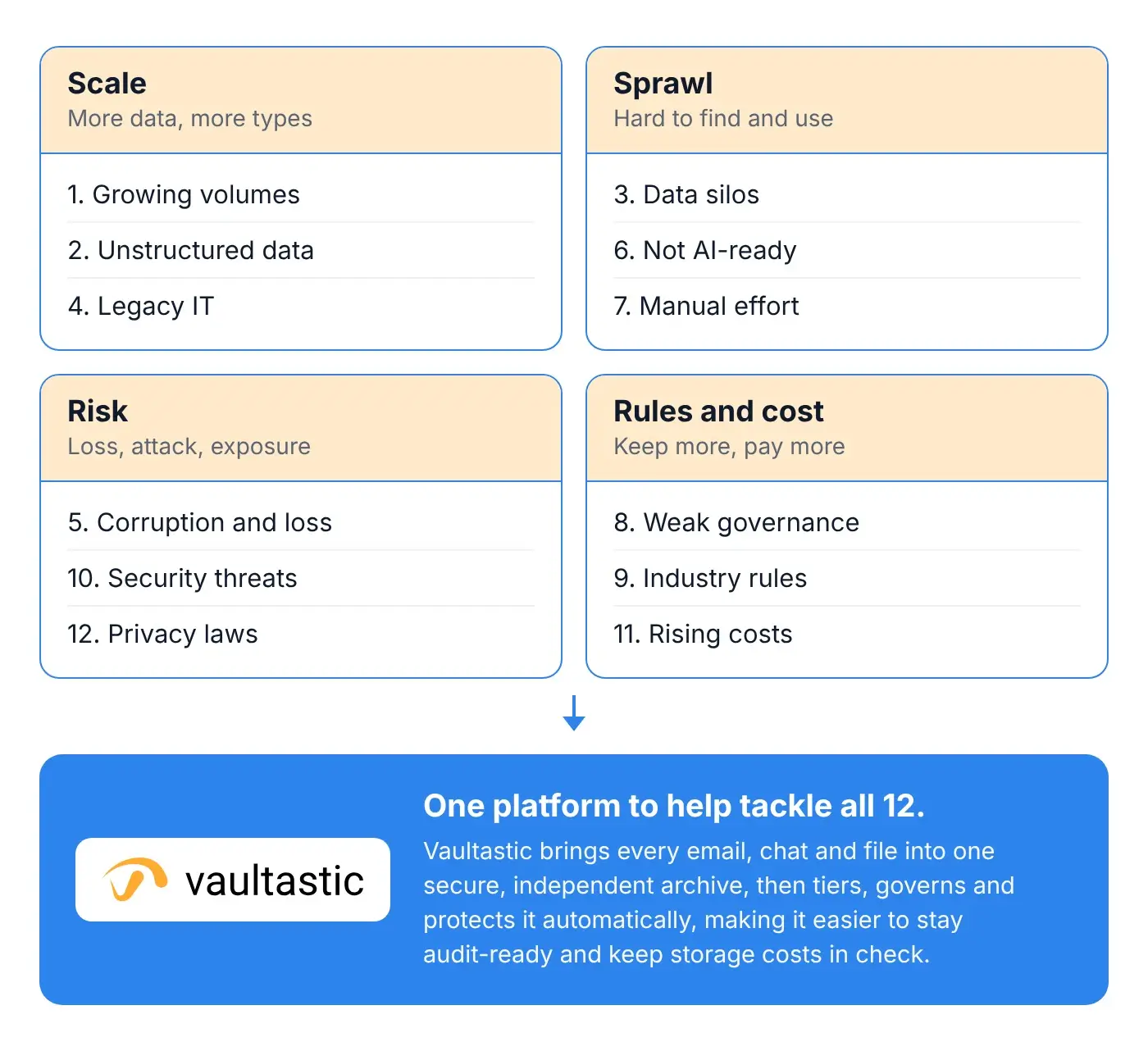
The challenges cluster into four pressures: Scale, Sprawl, Risk, and Rules, besides cost. A well-designed independent archive can help address them by improving data accessibility, resilience, governance and storage cost efficiency.
The 12 biggest data storage and data management challenges
1. Data volumes that keep growing, unpredictably
Data grows every year, and it rarely grows on schedule. A new SaaS app, an acquisition or a regulatory mandate can quickly add terabytes of data you. Over-provision and you pay for idle capacity; under-provision and your management load grows.
How to solve it: Use storage that scales on demand, and move ageing data out of expensive production system storage with retention and archival policies, so growth lands on the cheapest suitable tier.
2. Unstructured data and too many data types
Most new business data is unstructured: emails, attachments, chat messages, PDFs, scans, spreadsheets and recordings. It doesn’t fit neatly into databases, so it is hard to search, classify and govern. Every new source adds a new format and a new question: where does it live, how long do we keep it, who can see it?
How to solve it: Bring unstructured data into a central archive where it can be searched by content and other markers. Then answer five policy questions per data type: where it is stored, in what format, for how long, how it is disposed of, and who has access.
3. Data scattered across too many silos
Data sits in email platforms, ERP and CRM systems, file servers, cloud drives, laptops and backups. Each silo has its own access rules and its own search. Answering a simple question, such as “show me every message about this client”, turns into a multi-person task.
How to solve it: Consolidate copies of information records and assets into a central, independent archive that sits outside your production systems, with one search and one set of access controls across sources.
4. Legacy IT architecture
Older on-premises storage and legacy archives are expensive to maintain, hard to scale and often tied to software that is no longer supported. Migrating out is risky, so many organisations keep paying for systems they no longer use.
How to solve it: Plan a phased migration of legacy data into a cloud archive, validating data as it moves, then retire the ageing platform.
5. Data corruption and accidental loss
Disks fail, files get corrupted, and users delete things by mistake. Cloud email and drive platforms are not designed as long-term archives; deleted or overwritten data can be gone once their retention windows pass.
How to solve it: Keep an independent copy of critical data outside the production platform, with integrity checks and redundancy, so a system failures or deletion in one place doesn’t mean permanent loss.
6. Data that isn’t ready for AI
AI and analytics projects are only as good as the quality of data used. When data is duplicated, unclassified, incomplete, tampered or broken in silos, AI and analytics tools fails to deliver useful outcomes.
How to solve it: Treat AI readiness as a governance task: ensure automated data gathering and capture to ensure accuracy, know what data you hold, classify sensitive content, and decide which approved tools may use which data, rather than connecting AI tools to every data source without adequate protection.
7. Too much manual effort
Moving data between tiers, applying retention, answering audit requests and extracting data are still a manual job for many teams, making it slow, inconsistent and often incomplete.
How to solve it: Automate the data workflows and operations: policy-capture, marking, access, storage management, retention schedule, with automated audit trails generation, to ensure efficiency, accuracy and control.
8. Weak data governance
Without clear rules, nobody is sure what may be deleted, what must be kept, or who may see what. Data piles up “just in case”, which raises both cost and risk.
How to solve it: Write down retention, disposal and access rules by data type and role, then enforce them in the platform with role-based access control and audit logging, not by policy document alone.
9. Keeping up with industry compliance
Regulated organisations often must retain certain records and produce them on request. In India, SEBI, RBI and IRDAI each set requirements for the entities they regulate. The retention period, format and access rules depend on the regulator, the type of entity and the category of record, so there is no single period that applies to everyone. Failing to keep or produce a required record can lead to regulatory action under the applicable rules.
How to solve it: Work with your compliance or legal team to map each record category to the rules that apply to it. Then keep those records in tamper-resistant storage with retention policies and legal hold, and make sure you can search and export them quickly when an audit or investigation arrives. See our guides to SEBI data retention rules for brokerages and long-term data protection obligations.
10. Security threats and slow recovery
Ransomware and other attacks increasingly target backups and archives as well as live systems, and breaches are getting more expensive. The global average cost of a data breach reached $4.99 million, a 12% rise on the previous year and a record high (IBM Cost of a Data Breach Report 2026).
How to solve it: Layer your defences: encryption, multi-factor authentication, least-privilege access and an immutable, independent copy of critical data that attackers can’t alter.
11. Rising storage and management costs
Long retention periods, hardware refreshes, staff time, backup licences and disaster recovery all add up. Keeping years-old data on premium storage is one of the most common sources of waste.
How to solve it: Tier data by how often it’s accessed, keep only what you need on fast storage, and set lifecycle policies that move ageing data to lower-cost tiers. More in our articles on data lifecycle management and cost optimisation.
12. Privacy regulations and personal data
Privacy laws such as India’s Digital Personal Data Protection Act, 2023 (DPDPA) and the EU’s GDPR require organisations to protect personal data and to handle requests from the people it belongs to, which can include access, correction and erasure. These obligations come with conditions and exceptions; for example, data may need to be kept where another law requires it. In India, the DPDP Rules were notified on 13 November 2025, and most obligations on data fiduciaries, including notice, security safeguards, breach intimation and data retention, apply from 13 May 2027. Personal data hidden in old emails, attachments and scanned documents is easy to miss.
How to solve it: Build an inventory of where personal data sits across your archives, preferably use tools to automate the detection and set retention and access rules that reflect the the legal provisions and exceptions. Scanning for identifiers such as Aadhaar, PAN and bank account numbers can make that inventory much faster. Read how this applies to DPDPA compliance for Microsoft 365 and GDPR and email retention.
How to overcome data storage and data management challenges
Many of these challenges share a common thread: long-term data lives inside the same systems that run the business, with no separate layer built to keep it governed, searchable and affordable. A well-designed independent archive can help by ingesting data from many sources, applying policies automatically, and keeping each record on the storage tier that suits its age and use.
Vaultastic is built as that layer: an archival and data governance platform that runs separately from your production environment. Here is how its documented capabilities map to the challenges above.
You keep ownership of all archived data and can extract or restore it when you need to. To see this in practice, read how a regulated bank unified its archival or how an NBFC archives email for compliance.
| Challenge | How Vaultastic helps |
|---|---|
| Finding data | Full-text search for email and chat in the Active Store; file name, metadata, date and size filters for files in the Open and Deep Stores |
| Growing volumes, rising costs | Four storage tiers: Live Store for investigations, Active Store for email and chat, Open Store for files that must stay accessible, and Deep Store, the lowest-cost tier, for long-term retention. Deep Store files are restored on request, typically within 24–48 hours |
| Manual effort | Lifecycle policies move data between tiers by age, with thresholds administrators configure |
| Corruption and loss | Each lifecycle move is integrity-checked, and source data is removed only after successful verification |
| Governance and compliance | Retention policy enforcement, legal hold, audit trails and tamper-resistant storage, with immutable (WORM) archival options |
| Security | Encryption at rest, in transit and in use; multi-factor authentication; single sign-on; role-based access control |
| Personal data | Predefined scan requests that report which archived emails, chats and documents contain personal information such as Aadhaar, PAN, passport, bank account and credit card numbers |
| Legacy archives | Imports PST files, ZIP archives and mailbox migrations |
| Data residency | Region-specific deployment, plus a hybrid option with a customer-controlled Private Store |
Frequently asked questions
What are the biggest challenges of data management?
The most common are growing data volumes, unstructured data, data scattered across silos, legacy systems, security threats, compliance and privacy obligations, and rising storage costs. Most stem from keeping long-term data inside production systems with no dedicated layer to govern it.
Is data management hard?
It is hard when data management is manual and spread across many systems. It becomes manageable once data is centralised, policies for retention and access are defined, and tiering, retention and audit logging are automated.
What are the main data storage issues businesses face?
Running out of capacity, paying premium prices to store rarely used data, losing data to corruption, deletion or ransomware, and being unable to find records quickly when internal or external stake holders need them.
Why is unstructured data so hard to store and manage?
Emails, documents, chats and scans don’t follow a fixed schema, so they are hard to index, classify and search. They also tend to hide personal and regulated information, which makes retention and privacy decisions harder.
How can businesses reduce data storage costs?
Move ageing data off primary systems into an archives, tier it by how often it’s accessed, archive only the users and data you need to retain, and keep years-old data on the lowest-cost storage tier.
Get started
See how Vaultastic handles your data sources and retention rules. Book a live demo or start a 14-day free trial.