


As organizations prepare for the Digital personal data protection act (DPDPA), 2023, many have already updated privacy policies, appointed Data protection officers (DPOs), and strengthened consent management practices. While these are important milestones, compliance doesn’t end with documentation.
The real challenge begins when a customer, employee, vendor, or regulator asks:
- What personal data do you hold about me?
- Can you retrieve it quickly?
- Can you prove how it has been protected?
Answering these questions requires operational readiness – the ability to locate, preserve, govern, and retrieve personal data efficiently.
The hidden compliance challenge in Microsoft 365
A significant amount of personal data resides in everyday business communications, including:
- Emails
- Microsoft teams chats
- SharePoint documents
- OneDrive files
- Attachments containing KYC documents, contracts, and employee records
While Microsoft 365 is designed for collaboration and productivity, organizations often struggle to centrally discover and govern years of historical communication when responding to audits or Data Principal Access Requests.
This creates operational gaps that policies alone cannot address.
Where organizations face challenges
Organizations preparing for DPDPA commonly encounter challenges such as:
- Finding personal data spread across multiple mailboxes and repositories.
- Responding quickly to Data Principal Access Requests.
- Balancing retention and deletion to satisfy both privacy obligations and regulatory record-keeping requirements.
- Maintaining audit-ready records that demonstrate accountability.
- Protecting archived business communications from accidental deletion or tampering.
How Vaultastic helps organizations achieve DPDPA compliance
Vaultastic helps organizations address the operational requirements of DPDPA by securely preserving business communications, enabling centralized eDiscovery, maintaining immutable records, enforcing retention policies, and providing comprehensive audit trails.
While DPDPA compliance remains the responsibility of the organization (Data Fiduciary), Vaultastic equips organizations with the tools needed to capture, archive, secure, manage, centrally discover, and govern personal and private data collected across various business communication channels.
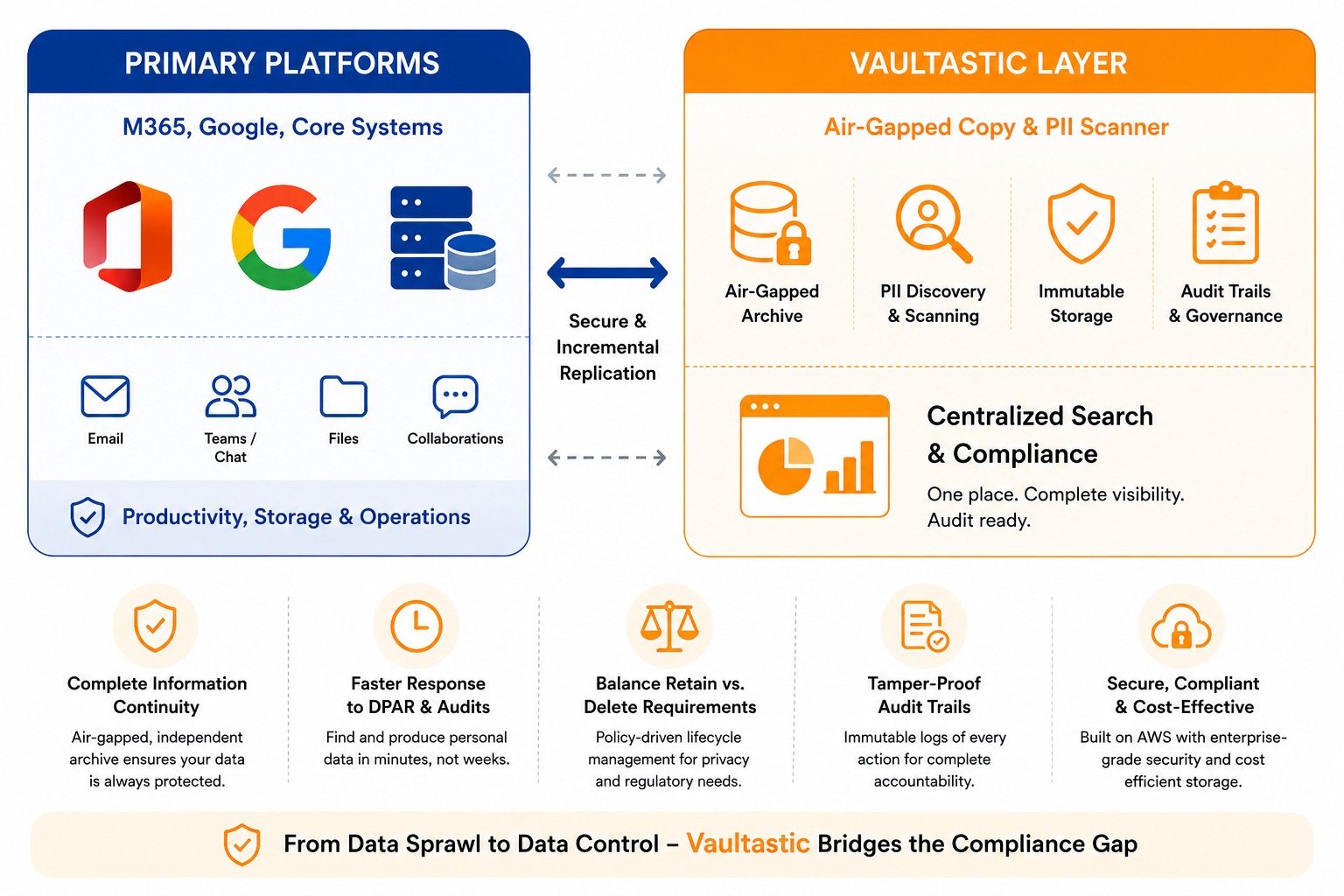
Respond faster to data principal access requests
Under DPDPA, organizations must be able to respond to Data Principal Access Requests accurately and within regulatory timelines.
Vaultastic’s powerful search and eDiscovery capabilities enable organizations to quickly locate specific archived information and business communications from a centralized repository. This helps compliance teams efficiently retrieve relevant information and respond confidently to regulatory requests, audits, and investigations.
Securely protect archived personal data
Vaultastic safeguards archived data through multiple layers of enterprise-grade security, including:
- Encryption at rest and in transit
- Immutable storage
- Role-based access controls
- Detailed access logs
- Automated monitoring
- Air-gapped, independent storage
These security controls help organizations protect personal data against unauthorized access while ensuring archived information remains secure, tamper-proof, and available whenever required.
Simplify data retention and lifecycle management
Vaultastic enables organizations to define retention policies based on business and regulatory requirements while automating data lifecycle management.
The platform supports secure long-term preservation of records and enables administrators to implement data minimization policies in accordance with organizational policies and applicable legal obligations-helping organizations meet both retention and privacy objectives.
Want to learn more about DPDPA?
Read our DPDPA FAQs for answers to common compliance questions or watch our on-demand webinar for a detailed discussion on DPDPA requirements and how Vaultastic helps organizations strengthen operational readiness.